Bible Cross-References
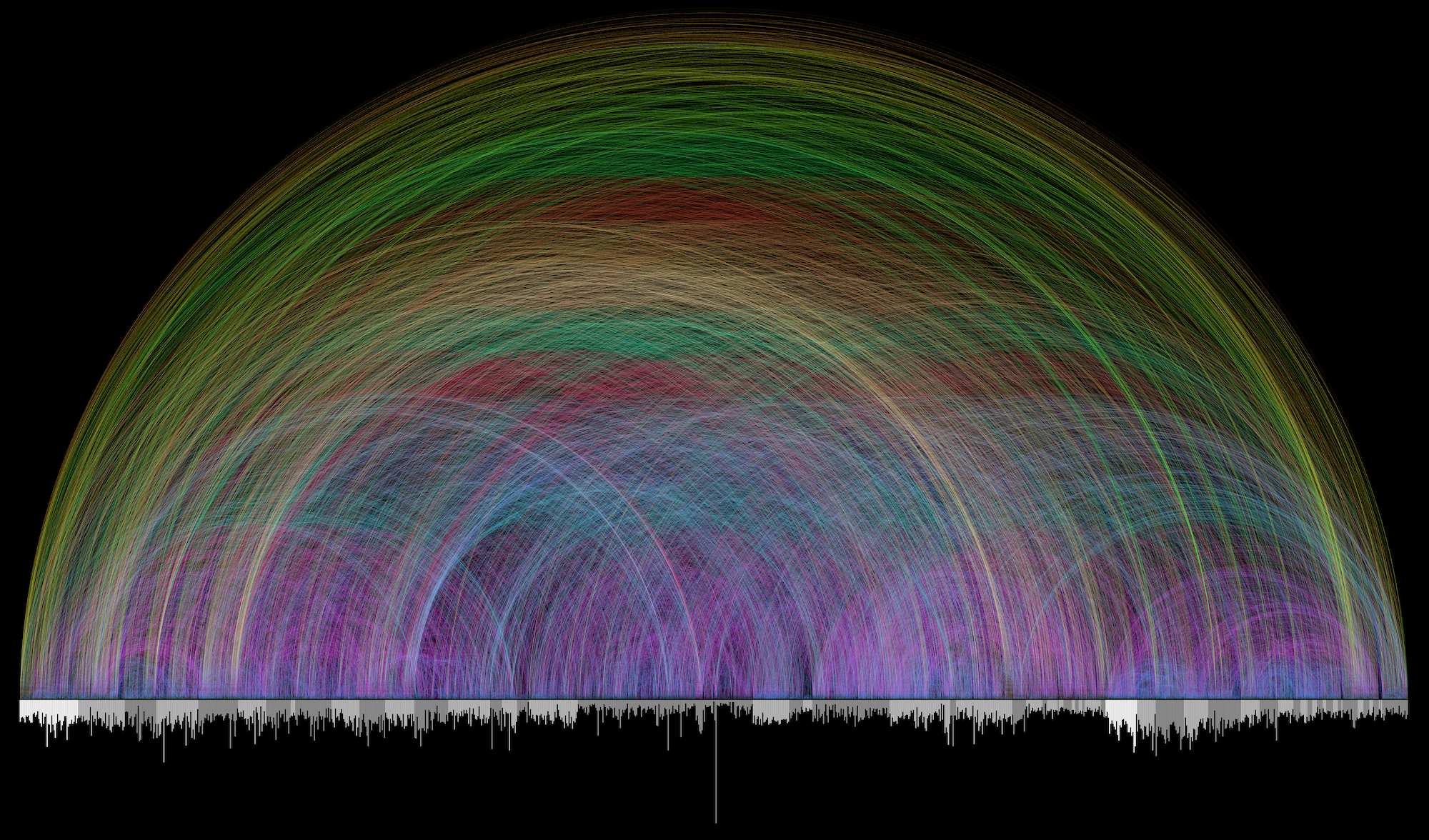
This set of visualizations started as a collaboration between Pastor Christoph Römhild and myself in 2007. He had assembled a digital dataset of cross references found in the King James Bible. Cross-references are conceptual links between verses, connecting locations, people, phrases, etc. found in different parts of the Bible. Cross-references are included in the margins or footnotes of some Bibles (example here). The pastor and I struggled to find an elegant solution to render the data – 63,779 cross references in total. We set our sights on something more beautiful than functional. At the same time, we wanted a visualization that honored and revealed the complexity of the Bible at every level – as one leans in, smaller details should become visible. This ultimately led us to the multi-colored arc diagram you see below. Jordan Peterson has included this graphic in his lecture series discussing how the Bible could be considered "the first hyperlinked book".
The bar chart that runs along the bottom represents all of the chapters in the Bible, starting with Genesis 1 on the very left. Books alternate in color between light and dark gray, with the first book of the Old and New Testaments in white. The length of each bar denotes the number of verses in that chapter (for instance, the longest bar is the longest chapter in the Bible, Psalm 119). Each of the 63,779 cross references found in the Bible are depicted by a single arc - the color corresponds to the distance between the two chapters, creating a rainbow-like effect. There is no text on the graphic.
| Hundreds of people have contacted me over the years asking for tips on how to achieve a high quality print. In many cases, going to a local shop and using their large format printer was very expensive and sometimes with disappointing output. To simplify this process and maintain high quality, I partnered with a local print shop and worked with their team to achieve a high quality offset print (36x22", including a 1" white border, 80lb paper). You can purchase these posters via paypal or credit card using the button to the right. There are also prints available on Amazon, signed (with real ink, by me) and unsigned. I batch ship them weekly in 2-foot long tubes and it takes a week or so to arrive, so please be patient. If more than two weeks has passed, please email me! Use Amazon if you want tracking information. Note that the posters look exactly like the "rainbow" image below and there is no text on the graphic (other than my signature, if you order a signed copy). |
Digital file download ($3.50): (you will be redirected to a webpage to download files at the very end; don't close the window.) |
Note this work is copyrighted and downloads of the graphic are intended for non-commercial, personal uses (holiday cards, invitations, wall poster, and similar). Purchasing this file does not grant a commercial use license.
If you really want to dig into Biblical cross references, I would suggest purchasing a Study Bible. If you want to go a bit fancier, I recommend this Study Bible. Alternatively, this version is a bit more basic, but totally functional.
 |
| Medium Resolution Download (free) 2000x1200 (2.4 Megapixels) | © Chris Harrison | High Resolution Download ($3.50) 12240x7200 (88 Megapixels) |
Biblical Social Network (People and Places)
Soon after finishing the cross-references arc visualization, I set out to create a new data set derived from the Bible’s text. This time I wanted to better capture the story, most notably the people and places, and the interactions between them. I did this by building a list of biblical names (2619 in total) and parsing a digital copy of the King James Bible. Each time two names occurred in the same verse, a connection was created between them. This produced essentially a social network of people and places. Because such relationships had no ordering or structure (unlike the cross references), I used a spatial clustering algorithm I developed for one of my other projects. This process causes related entities and highly connected groups to coalesce. I themed the output like an old piece of parchment.
Additional details: Entities with less than 40 connections are drawn at an angle. Those with 40 or more connected entities are rendered horizontally - size is linearly proportional to the number of connections. The graph contains over 10,000 connections, too many to be useful and thus made purposely faint as not to overwhelm the piece. The names On, So, and No were excluded since they are both names and words (and I wasn't doing anything clever like named entity recognition when parsing the text).
 |
| Medium Resolution (free) 2000x2000 | High Resolution (on Etsy) 4400x4400 |
Distribution of Biblical People and Places
With the biblical names list already compiled and a copy of the King James Bible sitting on my desktop, another visualization was inevitable. I settled on a classic distribution visualization, which shows where various people and places occur in the text. Much of the Bible is chronological, so there is a strong temporal ordering.
Visually, this is the entire Bible printed on a single piece of paper (you'll need to look at the high-res version to see it). Floating above the text are the people and places that appear in the Bible - more than 2,600 names in total. These are positioned according to their average location in the text. Faded lines are rendered to show where they occur. Additionally, font size is proportional to the number of occurrences in the text - the larger the name, the more frequently it appears. The names On, So, and No were excluded.
I've provided the visualization in three color themes. Additionally, because the graph is so dense, I've included two extra versions for people who really want to study it up close. These are simply splitting the content - the "All Names" version is the two combined. You really need to download the high resolution versions to see all of the detail.
| All Names | Less Frequent Names Only | More Frequent Names Only |
 |  |  |
 |  |  |
 |  |  |